


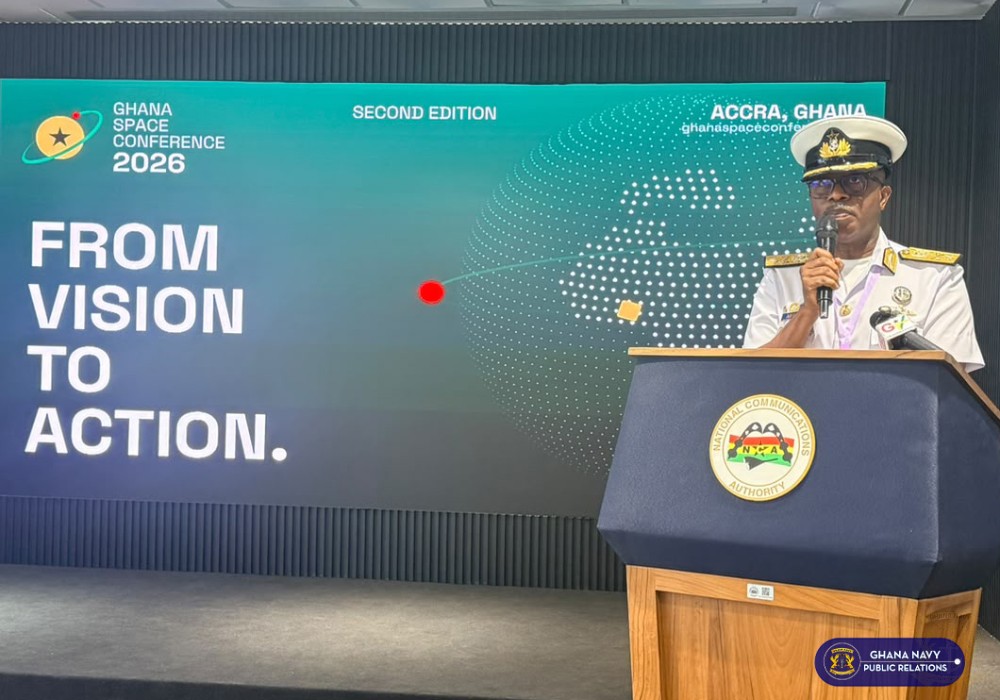
The Ghana Navy has called for greater integration of space-based technology into maritime security operations to strengthen surveillance, improve intelligence gathering and enhance the protection of the country’s maritime resources.

The call was made by the Chief Staff Officer (CSO) atthe Naval Headquarters, Commodore Ben Baba Abdul, who delivered a speech on behalf of the Chief of the Naval Staff, Rear Admiral Godwin Livinus Bessing, at the Ghana Space Conference 2026, held on Monday 16 November 2026, at the National Communications Authority (NCA), Airport, Accra.

Speaking from the maritime perspective of Ghana’s space industry, Commodore Abdul noted that Ghana’s maritime domain, which supports approximately 85 per cent of the country’s trade and hosts important fisheries and offshore oil and gas activities, required reliable surveillance systems to safeguard national interests and economic activities.
He added that Ghana’s Exclusive Economic Zone, covering approximately 225,000 square kilometres, presented significant monitoring challenges for the Navy, given the limitations of conventional surveillance assets. He explained that naval vessels, coastal radar installations and aircraft could not provide continuous coverage of the entire maritime domain, leaving gaps that could be exploited for illegal fishing, trafficking and other maritime crimes.
Commodore Abdul identified satellite technology, particularly Synthetic Aperture Radar and satellite-based vessel identification systems, as important complements to existing surveillance capabilities.
These technologies, he said, could help detect unusual vessel movements, monitor activities across Ghana’s territorial waters and inland waterways, and provide intelligence on vessels operating without identification signals. He added that integrating satellite-derived information into maritime operations would support intelligence-led decision-making and enable the Navy to deploy its operational resources more effectively.
Also delivering a presentation on the topic, “Maritime Perspective on Ghana’s Space Industry,” Commander Philip Odoi-Narh called for greater integration of space technology into Ghana’s maritime industry to strengthen surveillance, improve security operations and create opportunities for local businesses.

Commander Odoi-Narh emphasised the need for Ghana to move beyond being a consumer of space-based information towards developing local capacity to analyse satellite data and provide practical solutions.

He encouraged collaboration among government agencies, academic institutions and private-sector players to develop services in vessel detection, port and shipping monitoring, and environmental surveillance, noting that such initiatives would strengthen maritime security while promoting innovation and growth in the country's space industry.
Story by : Rabiatu Dery
Pictures by : LS Gonda Zumeseg Juliet


